

A root smudge is a toner applied at the roots to blur the hard line where your natural color meets lightened hair. It is not a lightening service. Balayage lightens; a root smudge softens where that lightening begins. Most balayage appointments include one.
What does a root smudge actually do?
When hair is lightened — by balayage, highlights, or any other method — the lightener has to start somewhere. That starting point can leave a visible demarcation line between your natural base and the lighter hair below it.
A root smudge fixes that. Your colorist applies a toner through the root area and feathers it down into the lightened hair, so the two blend instead of meeting at an edge.
You will hear three names for roughly the same idea:
- Root smudge — toner blurred through the root area
- Root melt — the same idea, usually blended further down the strand
- Shadow root — a deliberately deeper root left as a design choice, not just a blur
What is the difference between balayage and a root smudge?
They are two different steps, and most people get both in the same appointment.
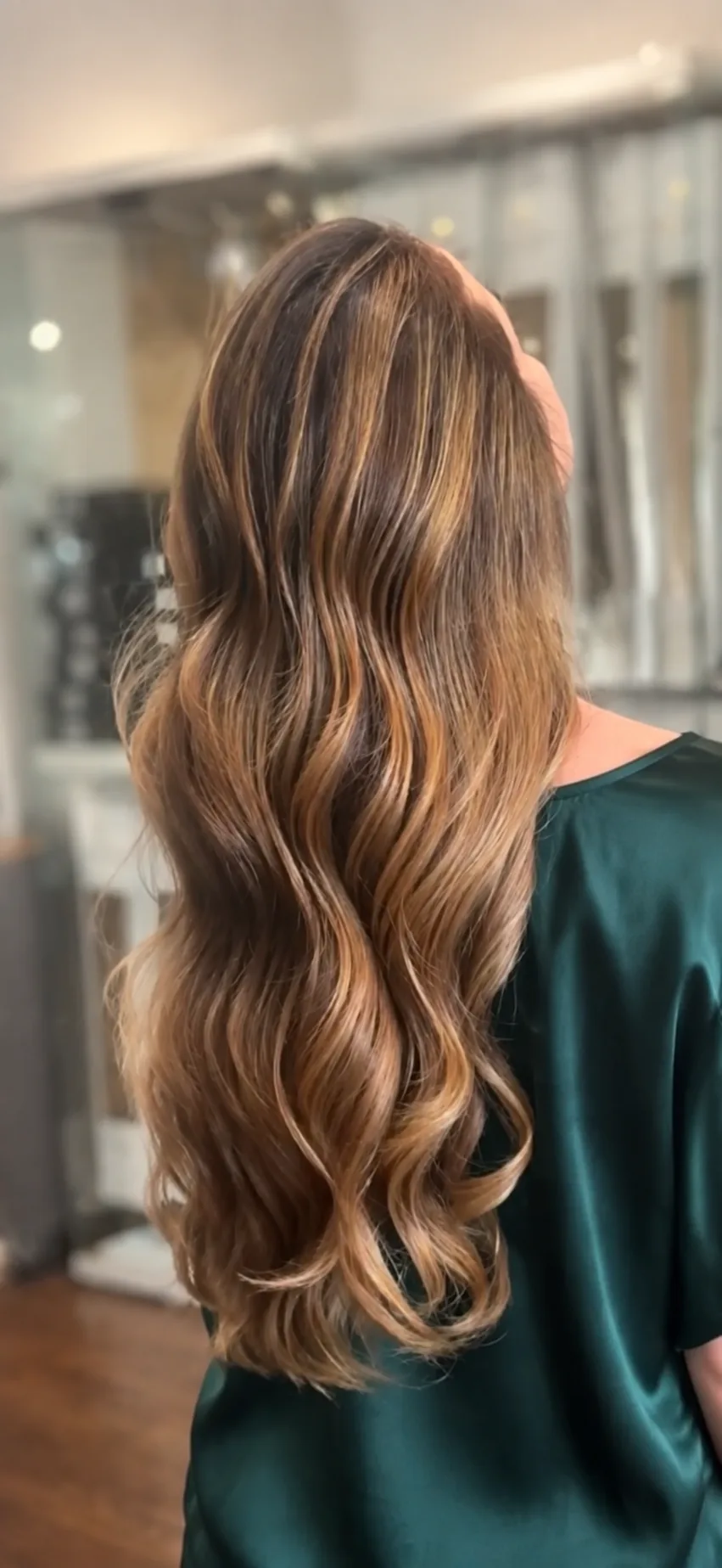

| Balayage | Root smudge | |
|---|---|---|
| What it is | A lightening technique — color painted freehand onto the surface of the hair | A toning step at the root |
| What it does | Creates lightness through the mid-lengths and ends | Blurs the line where the lightening starts |
| Does it lighten hair? | Yes | No |
| Can it be done alone? | Yes | Yes, but usually done with a lightening service |
Asking whether to get balayage or a root smudge is a bit like asking whether to get a haircut or a blow-dry. They are not alternatives. One lightens, the other finishes.
Does balayage include the roots?
Short answer: usually not, and that is deliberate. Here is what balayage actually does at the root, including how close it can go and how the grow-out compares with foil highlights.
Usually not — and that is the point.
Traditional balayage is painted starting below the root so the grow-out stays soft. That is what makes it lower-maintenance than a foil highlight taken right to the scalp: there is no sharp regrowth line to chase.
A root smudge takes that further by deliberately blurring the transition, so as your hair grows the change is gradual rather than a band.
If you want lightness at the root, that is a different service — a full highlight or an all-over lightening — and it will need more frequent upkeep.
How often does a root smudge need refreshing?
Most people refresh a toner or root smudge every six to eight weeks.
It is not only about color. Refreshing adds softness back into the texture — something you feel as much as you see — and it brings the shine back. Long hair benefits the most, because the ends have been through the most.

Is a root smudge the same as a toner?
Yes — a root smudge is a toner. It is not a third product or a separate service. It is a toner applied at the root and feathered down, so the only thing that makes it a “root smudge” is where it goes and how it is blended.
That is why the question is never really which product do I need. It is whether the toner is part of a lightening service or a refresh on its own:
- With a lightening service — balayage, highlights, anything that lifts — a toner starts at $50.
- As a refresh between lightening appointments, a toner starts at $75.
- A root smudge is never billed separately. It is how the toner is applied.
The lower price is a break for clients already paying for the lightening that day. You can see the full color price list for everything else.
What does balayage with a root smudge cost in Baton Rouge?
Balayage starts at $165. Nearly every appointment adds a toner at $50 and a style at $50 — about $265. With a haircut instead of a style it is about $280. The root smudge itself is not charged separately — it is how the toner is applied.
Those are the lowest prices, not averages. Hair is variable — length, density, how much lightening the look needs, and how much product it takes all move the number, and there is a product cost fee on top. Your actual price is worked out with you at the consultation, before anything starts.
Refreshing the toner between appointments starts at $75.
How long does the appointment take?
Plan about four hours. Balayage is booked with a toner and a finishing style, and four hours is the realistic total. Allow a little longer if you have a lot of hair or it is especially long.
Who is a root smudge right for — and who is it not?
It is right for you if
- You have lightened hair and want a soft, low-maintenance grow-out
- You are stretching time between appointments
- You want depth at the root without losing brightness through the ends
- You are transitioning away from a highlight that grew out with a visible line
It is probably not for you if
- Your hair is not lightened — there is no line to blur
- You want brightness right at the scalp; you want a full highlight instead
- You want zero root definition at all
Common questions
Is a root smudge the same as a root melt?
Close, but not identical. Both blur the line between your natural base and lightened hair. A root melt is usually blended further down the strand for a softer, longer transition.
Can you get a root smudge without balayage?
Yes — on any lightened hair, including foil highlights or an all-over lightening. It just needs lightened hair to blend into. As a refresh between appointments, that starts at $75.
Does a root smudge damage your hair?
A root smudge is a toner, not a lightener, so it is not the part of the appointment that lifts the hair. Refreshing it every six to eight weeks also puts softness and shine back into the ends.
Will a root smudge cover gray?
No — and it is not meant to. A toner is designed to soften a look, not to cover it up. It is translucent: it sits over what is already there rather than replacing it. On gray, that means it will take down the contrast and calm the brightness, but you will still see the gray. That is the intended result, not a shortcoming.
If gray is the reason you are booking, there are two different paths. Gray coverage replaces the gray with pigment, and every regrowth brings a line back. Gray blending uses lightening and toning together so the gray reads as dimension instead of regrowth — no hard line every four weeks, and a far gentler grow-out as more of it comes in.
A root smudge is often the finishing step in that second approach. It is not the whole plan.
Book it
Eutopia Salon has done hair color and extensions in Baton Rouge, and nothing else, since 1996.
Balayage starts at $165 — about $265 with a toner and a style, or $280 with a haircut. Plan about four hours in the chair — a little more if you have a lot of hair or it is especially long.
Those are starting prices, not averages. Your real number, including the product cost fee, is worked out with you at the consultation before anything begins.
A deposit and an online account are required to book — worth knowing before you start, so there are no surprises at checkout.
2355 Cedardale Ave, Baton Rouge, LA 70808 · (225) 344-4386
Mon 9–5 · Tue–Fri 9–8 · Sat 9–5 · Sun closed


